crits laudations recensions reviews honorific speech - excerpted pieces - german
From: Lynda Leighton <lynda_leighton@yahoo.co.uk> To: Pakery <mixedmedia@pakery-kulturbaum.ch>
Sent: Friday, 22 August 2014, 12:14 Subject: artsommer at the UPK CH-BASEL
Dear Paula_ I really enjoyed the exhibition and the thoughts that your work awakened in me. I feel they are very aligned to the thoughts I have when I am working (when I get the chance!).
The two paintings are very impressing and work fantastically with the Exhibiton title "verWegen". There is a conversation between the two works, but I will try and comment separately.
Ich esse Himmel – I eat heaven:
The words I wrote down at the time - The origin of species by Charles Darwin, "It droppeth like the gentle rain from heaven" William Shakespeare, pollination.
I have tried to look at some ancient Mayan poetry. Some of there poems are very beautiful. I read a lot when I was a college, but most of the writings I have in England, but I find them very inspirational.
I found these 2 writings (although not original Mayan) by Ariel Spilsbury & Michael Bryner. The Mayan Oracle: Return Path to the Stars. I thought this as a title would also fit to your "Dance between Heaven and Earth.
Imix:
As you are trusting and receptive
I sustain you with the wine of many gifts
I bathe your seed essence with abundent life force
for I am primal sound of creation
the potent energy and vibration of the undivided waters.
Ik:
I dance and soar
life's essence infusing time and space
Mystic reunion dive.
I am inspiration as it flies!
Let me lift you, free you, fill you,
enfolding you with the song simplicity can sing!
I also include Shakespeare's quality of mercy:
The quality of mercy is not strain'd,
It droppeth as the gentle rain from heaven
Upon the place beneath: it is twice blest;
It blesseth him that gives and him that takes:
Tango zwischen Himmel und Erde – Tango between Heaven and Earth
The words I wrote down at the time: Afterlife (uberfahrt), Egyptian underworld. darkness into light. dance of the butterflies, bees, swan, migration. This piece for me is both poetical and musical.
It certainly made me think of the uberfahrt, which I think is a great words to discribe the passing over from life into death (afterlife). from darkness into light. It is encapsulates the death of an Egyptian king that starts above ground, that leads underground and that ends with an opening to the skies through which the Gods were launched heavenward. (Aida - last Act music).
I know I had a Mayan poem that made me think of butterflies and the transcience of life and I can sense the aura of a butterfly in between Heaven and Earth. I found this poem, which not perfect says something of what I feel.
The time has come for the butterfly to spread its wings
to share beauty and grace
as it soars beyond to learn new things.
See its rainbow of colour dancing in the clear blue sky
like tiny jewels of pureness,
too beautiful to pass by.
Time has prepared it for this transition now
and by following its path
it will be shown how.
To dance with the soft breeze stroking its cheek with a sigh
the sparkle of sunlight glitters on its wings as it flies.
Towards a freedom that will be bound forever more
courage gives it power and "will" to open new doors.
Far beyond the boundary of the world it has known
to experience the mystery of new realms, it is shown.
Truth keeps it fluttering to the center of its core
which brings joy and passion
based on feelings for?
Living life to full potential - in the "now"
if it keeps its heart open
it will be shown how.
And trust will release any frear that it feels,
unconditional love will keep it on an even keel.
The hourney will be long and very hard at time
but the delicate butterfly will dance and sing to the chimes.
For the wind and songbirds who are its friends
will gently guide it along its path until it reaches the end.
And its wings strength will never let it fall
because the butterfly is special and will conquer all.
Margaret Jang
The black clusters of paint also made me think about swarming bees or birds in migration. Fitting music would perhaps be the Flight of the bumble bee by Rimsky Korsakov! As the bumblebee flies away the Swan Bird calls: Gvidon, fly, only do not stay long!
Moreover, I am reminded of the dying swan and the music of the dying swan from swan lake can be heard.
Lord Tennyson Verse 3
The wild swan's death-hymn took the soul
Of that waste place with joy
Hidden in sorrow: at first to the ear
The warble was low, and full and clear;
And floating about the under-sky,
Prevailing in weakness, the coronach stole
Sometimes afar, and sometimes anear;
But anon her awful jubilant voice,
With a music strange and manifold,
Flow'd forth on a carol free and bold;
As when a mighty people rejoice
With shawms, and with cymbals, and harps of gold,
And the tumult of their acclaim is roll'd
Thro' the open gates of the city afar,
To the shepherd who watcheth the evening star.
And the creeping mosses and clambering weeds,
And the willow-branches hoar and dank,
And the wavy swell of the soughing reeds,
And the wave-worn horns of the echoing bank,
And the silvery marish-flowers that throng
The desolate creeks and pools among,
Were flooded over with eddying song.
I hope I have seen something of what you wanted to convey in these paintings, it certainly gave me plenty to think about and I have enjoyed the chance to do so. I hope I have in turn given you something to think about!
Much love Lynda xXx
William Shakespeare, Der Kaufmann von Venedig 4. Akt. Es tropfte wie milder Regen vom Himmel
“The quality of mercy is not strained.
It droppeth as the gentle rain from heaven
upon the place beneath. It is twice blessed:
It blesseth him that gives and him that takes.
'Tis mightiest in the mightiest. It becomes
The thronèd monarch better than his crown.
His scepter shows the force of temporal power,
The attribute to awe and majesty
Wherein doth sit the dread and fear of kings,
But mercy is above this sceptered sway.
It is enthronèd in the hearts of kings.
It is an attribute to God himself.
And earthly power doth then show likest God’s
When mercy seasons justice. Therefore, Jew, Though justice be thy plea, consider this-
That in the course of justice none of us
Should see salvation. We do pray for mercy,
And that same prayer doth teach us all to render
The deeds of mercy. I have spoke thus much
To mitigate the justice of thy plea,
Which if thou follow, this strict court of Venice
Must needs give sentence 'gainst the merchant there.”
Seidenweg 55 4242 Laufen-Basel galerie kulturforum.laufen exhibition Phenomena of the cycle 21.11.–14.11. 2008
Honorific speech of Dr. Markus Ramseier (retold by ppk)
I begin aptly with the bee blessing manuscript from the monastry of Lorsch - a magic spell. The dual function of this spell has led to the view that it is a combination of two older spells. The tone is remarkably gentle, and the relationship to the bees almost intimate. The spell was written upside down on the border of a page of the apokryptic “Visio St. Pauli” in the early 9th centuary. which is now in the Vatican. It belongs to the oldest rhymed composi- tion in the old high german language.
Wood chopping creates a woodpath and Pakerys way is the woodpath where the harvest will be brought in – a beautiful sensual way. An engagement of the artist in materials which shaped our region since thousands of years, namely wood and beeswax. It is a dialogue with matters which have to do with the archaic and the mystery such as the old bee bles-sing of Lorsch tells us. It is like a return to the roots from where the human being origi-nates, a return to the nature and to the cosmos. And in this return I feel a very high year-ning. Such a longing of tranquility, peace and harmony infecting even me.
Many artworks come across to me as archaic landscapes of primeval times, bubbles of colours and tunes, weaved across with veins, water veins, life veins steeped in light and shadow. These pictures tells us stories and the nicest part of it is: each one another.Beforehand I take as example the picture “lithosphere – cosmos” 1x1 m. It is crea-ted: jute on wood with beeswax, pigments and metals, divided into four parts by two crossing lines, not drawn with a ruler but natural lines jagged at the borders. A circle, not quite round and unclosed. A crater where I believe I can hear a volcanic bubble. To that as well are added lines which are bundled and bunched together, the cross of coppery sulphurous rusty violet-black tints. A my-sterious landscape strange but nevertheless close – narrated in a manner of an original language. A landscape which makes me lively by the view and causes to me all kinds of associations. Thus I discover little hills and humps, tiny gully ero-sions and gutters. It speaks to me specially as thiugh I am a scientist for field names.I can feast on the artworks, pursuing with the eyes. But I can also sniff at them. They smell warm and soft of wax. A fleshly event! The artist has set herself apart with the nature, with the elements, with the elementary an individual manner and therefore has a distinct characteristic. She searches her own light and leaves herself time for it. Thus the picture “peace of mind - a present to you – I know the space, the time” is getting involved with the very great symbols which occupies also me as a writer. Space and time between the human being somewhere among in the double eternity searching after a response, after memories and after ones inner soul. This artwork is strewn with traces. It has a centre and there is again a circle. All the traces gravitate towards or also away. Seen as a composition it eradiates a peace. These are living pictures telling us whole stories
Your are so white, so tender in these golden hours, another poetic sensual title. Another circle of life in pulsating bluetones brightly lit from behind and enframed in darkness. But each bluetone is filled again with pulsing undertones. However, the finishing applied by the computer has frighten me somehow. What seems strange to me here - I am not a technofreak – finally the composition emerges itself as a very beautiful fusion. There nature, culture and technique are reconciled then nothing is for its own sake and Pakery never operates with self-censorship.
She offers us also a “fifth season” so rings another title. Layer by layer beeswax is built up, kneaded, sometimes supplemented with sand, natural fibres or other materials. Lines are carved into the structures setting in like scripts. Accompanied with a passion of mind from another deeper consciousness, from other energy fluxes and encounters, with the unconciousness which it turns over a new leaf and with the unexpected which surprises us then even oneself. I think in this way for myself because I have not talked to her. If in this case it is thought that the fourth or the fifth season as meaningless I don’t even have to know it is. To put it simply, it is a picture which pleases and inspires me. It radiates harmony und here the mysterious shining light appeares soothing.
A next title is “dust of the stars and substances” with the slogan of the Indian veda “god is sleeping in the stones, breathing in the plants, dreaming in the animals and awakening in the human being”. So I have the impression that those pictures are directly painted with dust of stars and that they do not conceive the fortitude and the light from here but rather are born out of a secret Each human being is finally a riddle - an expression of the inapprehensible. It comprises much more invisiblity than visibility even when nowadays a lot of people do not perceive it.
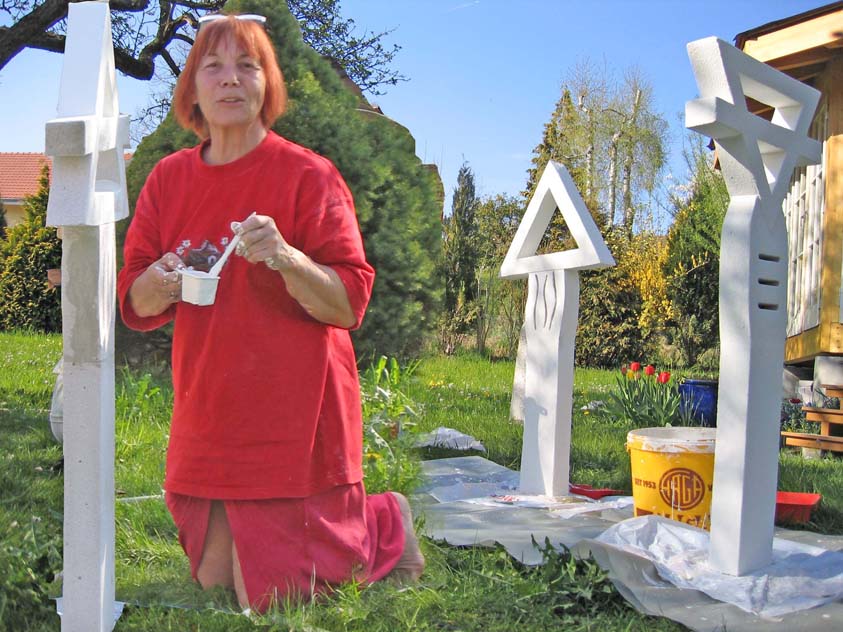
In the midst are the stelaes with mysterious carvings which refer to the celtic elements air - fire - water - earth after the Trill Symbiosis “securitiy and holiness” and put this room in a special oscillation. These oeuvres definitely want you to see below the surface. The artist wants much more and gives much more credit also to the viewer. So she makes an offer to our spirit and to our phantasies. Because her artworks move between the interme-diate and underworld on the border between visible and invisible, gives a under-standing under the philosophy of riddles. For me the interaction with wood, beeswax, sand, metal, natural fibers and stones are a positive expression of a resistance against the mega-important hit and run spirit of the time and the event culture. It is an exquisite elaborate resistance which bears fruit because it leads to an ensouled cheerful genuine world. It has much more to do with us and our roots. I feel in the artworks a high reverence and respect for the last secrets.
For many years an unknown homeowner has painted a saying on his housefront on a wooden beam. The writer Henry of Kleist saw this saying and he liked it so much, that he wrote it down. The saying also impresses me because it gives the mystery so much space and ends so bright: “I live and I don’t know how long, I die and don’t know when, I go and don’t know where, I wonder that I am so glad”. In this spirit cheers to the bees, to the artworks and to the riddles and a joyful continuation of this opening and exhibition.
Time travels - Art house S11 CH-4500 Solothurn - Hans R. Fröhlich, art critic, Solothurner Zeitung (daily newspaper of Solothurn) The culmination of a family tradition cultivated by generations of artistic personalities manifested in Paula Pakery`s a special artistic family-film beside the multifaceted art exhibition. In this colourful time travel she records with sound and images acting talents of her family tradtion. Already her great-grand-father made a living from creating paraments as a fashion and textil artist. The grandfather was a music hall singer and cabaret artist and Paula`s daughters are a singer and an actress on the stage. Multifaceted phantasy world: This joy trough play and creativity fixed on a DVD ranks top as an artisic expression of Paula Pakery. Soft coloured omputer supported art prints attest not only to Paula Pakery ability with electronic media but also to a narrative faceted fantasy world created with touching charisma and an inexhaustible wealth of ideas as is also true of her bright beeswax paintings. The artist models beeswax, natural fibers and pigments creating minute and multilayered compositions with archaic signs and shapes on wood or linen in soft lustrous golden earthy browns.
Hanspeter Flückiger, art critic, 24.10. – 18.11.08 - Solothuner Tagblatt (daily newspaper) arthouse S11 Solothurn invites you to time travels - an exhibition with stand points outside of our asccustomed three dimensional world. ....Who doesnt like being under way dreams of travels in thought- spaces? This yearning underlies Pakery`s artworks at the arthouse in Solothurn. Pakery experiments with the circle of life a situation in which everyone somehow and somewhere is positioned and moving. Artworks which provoke our cogitation. In nature, so says Pakery, the cycle of life for the human being is performed as life circles. She explores the moment and the temporality of time in moments and stations. Therefore she uses mainly beeswax which – repeatingly – she applies on the linen or wooden painting ground. Her sculpures symbolise the four elements air – fire – water – earth. The Installation „dreams of blossoms“ has a sacramental character. Bright-shiny light-bowls like dew drops give the picture "Core - the cycling of the seasons" a special aura.
Ruth Vuilleumier art historian Time travels – a wonderful title – which invites us to get rich in associations. In time we travel at the speed of light or much faster in our thoughts, memories und emotions. Being evocative of our ancestors we are suddenly also beside them, even if they are dead a long time ago. impressionable internal pictures awaken those in us each one a part of his own life story. Pakery Mixedmedia: her artist name tells us already that she works with a variety of materials and technics. The color application of her paintings consists mainly of pigments set with beeswax which she layers on the painting ground building up, kneading, sometimes supplemented with sand, natural fibers or other materials. In those layers she carves structures such as signs, symbols, chiffres etc. In doing so she evokes strong emotions which bind us with the energy of nature und put us in arcaic landscapes which waft us away towards cosmic spheres or twirl us in airy energy fluxes. Pakery`s computer supported art prints desplayed by computer animations reflect a fantastic mysterious magic on us. The artist creates and flowers out using a few photos and some drawings of the unimpressive cloverleafs new universes and poetic worlds of pictures. The appreciation of nature, the flora, their shining and phosphenes accompany us through Pakery`s entire work. We also find the alchemy symbols of the four elements earth, air, fire and water on stelas vegetated with grass and part of plants. Bright-shining light-bowls like dew drops gives the picture „Core - the cycling of the seasons" a special aura. A dark dense color circle like the inside of a sunflower symbolises here the bounteousness of the nature. This aura concentrates itself in the center and from there splendiously portions out as a giving and taking. This vital richness we absorbe from Pakery`s entire oeuvre touches all our senses and feeds our soul.
Exhibition Circle of Life - Museum CH-Arlesheim-Basel 2007 Wochenblatt weekly news - Author: Dora Mince, art critic, Contemplation with Pakery - A room capturing installation welcomes the visitor in the groundfloor of the museum. A floor-ceiling sculpture incorporating earth, fire, water and air transparent and gently ascending – similar to a life stream – end in paradisiac wings. On the walls there are paintings out of the fascinating material beeswax. They just pick up the viewer in the own circle of life somehow and somewhere. A computer animated installation „lucky.clover“ including 15 plots conveys the longing search for luckiness. At the forecourt Pakery placed another installation out of natural material and with archaic subjects. The sculptures symbolise the four elements; in the middle stands the fihth symbolising man and love. At the historical cemetery with an old monestry garden as an sensuous experience Pakery presents her show tables for the plants in the form of exciting short stories captured and recorded as contemporary documents. Meaningful things which are stamped by their very own intrinsic signature of the circle of life. They bring us where to where we are contemplatly that we generally carelessly pass things. A visit to this manifold and attractive capturing exhibition is highly recommended.
Basellandschaftliche Zeitung Annemarie Maag, art critic Circle of Life at the Museum CH-Arlesheim (24.05.-10.06.07)....Pakery brings to the theme „Circle of Life“ different technics. Installations and at the fourcourt include small sulptures as well as illuminated winged and mysterious fleese figures which in the huge exhibition room extend from the bottom till to the ceiling are primarily striking to the eye. In addition there are paintings based on beeswax with pigments in rich subtle graduation as well as extraordinary fine art prints. All thematically embeded in the circle of year, in circles of life and – lines, in the process of times and into „Dying and Becoming – Sterbe und Werde“. Observing in this way the exhibition is a total art work...... Pakery lets the natural inward tunes of the beeswax paintings organically melt into one another. Usually exhibitors avoid putting computer supported prints alongside painted pictures; here they enrich each other.
gallery zangbieri unterer rheinweg 22 ch-basle review Basler Zeitung Regio Magazin 27.12.2005 - 02.012006, Renate Dürst art historian & journalist: Brave beautiful world of plants In her workings Pakery narrates stories which activate deep associative currents. With creativity and phantasy the swiss artist Pakery has known for years how to call attention to herself. Experimenting with media such as photography, film and video, her repertoire also includes classical painting and creating art objects through the reworking of everyday objects made from materials such as wood, glass and steel. ARCHAIC. At the centre of her creativity are the paintings in which Pakery uses archaic materials and very direct original drawing symbols: for example beeswax applied in thick layers on linen or on wood tablets with carved broken scribing into mysterious signs, signals and codes. This causes the atmospherical association streams which activate the narration.
AMBIGOUS. Her last exhibition (16.12.05 - 15.01.05 - gallery at the Rhein Zangbieri, CH-Basle)”Insights into the flora” shows paradisiacal scenes with beautiful trees, fruits, plants, flowers, nectar and honey. Visions open in the pictures on linen in which the artist Pakery with ambiguous electronic reworking and finishing inspires in the viewer a curiosity beyond the surface.
Basellandschaftliche Zeitung Stefy Plattner art critic 18.12.05- 26.01.2006 Under the title „insights into the flora“ the gallery zangbieri, Unterer Rheinweg 22 in Basel/Switzerland presents a collection of about 40 works created by Paula Pakery. With the expression „mixedmedia“ the artist points out the uses of the different technics. Sometimes it is he use a photographical or pictoral base which has then been overworked with computer assisted. With a special insight e. g. into a blossom or cranny of the plant. Pakery discovers the mysterious structures and elements of seeds which then appear in other picture blown up in floating form again. Rhythmically structured they give the impression of sometimes vertical created transformations of vegetable fibers impressing a strong growth, whereas on another part large sized compositions are lattice-like overlayed with computer pattern.
Basler Zeitung, Dreilandzeitung, Sigmar Gassert, university lecturer for media science:..."What one finds phenomenal in Pakerys art work is the variation between the known and the unknown and the discussion in the pictures about our being. This happens in the well known signs und symbols, sensitivly done in simple basic patterns of geometrie. Through her artworks Parkery communicates a sense of the spirituality of beings and this amazes the viewer with an unspeakable dispostion of happiness. This is so far above us that we normal people prefer not to go there and instead prefer to be impressed by the collage art-works which are always series of photos taken out of videos each one identifying another face. One Closes the eyes so that one can phantasise „like a wild man“.
|